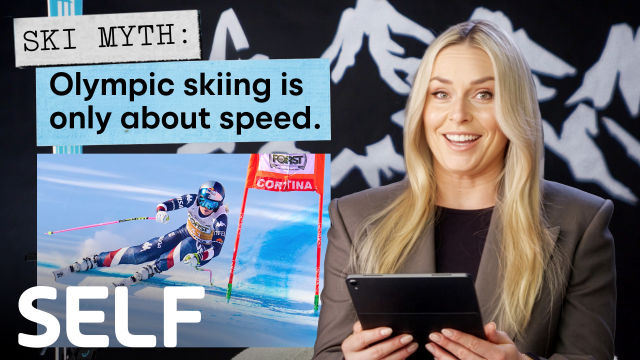
Olympic Champion Lindsey Vonn Debunks Every Ski Myth
Released on 01/22/2026
If I'm going 85 miles an hour, that's not fast enough.
I don't get to the bottom of the mountain
and say, you know, Oh wow, I was going 85.
I was like, [beep], I could have gone 86. You know?
That's like more my mindset.
Hi, SELF.
I'm Lindsey Vonn and I'm going on the record
about all things skiing.
[bright music]
Olympic skiing is solely about speed
and going downhill as fast as you can.
Technically, yes,
but it's a little bit more complicated than that.
In downhill skiing, it's about going as fast as you can,
but the other disciplines are a little bit more complicated.
There are actually five disciplines.
There's downhill, which is the fastest,
super-G, which is a little bit slower but similar.
There's giant slalom which is more turns.
And then there's slalom.
And then there's the combined which is a combination
of downhill and slalom together.
The skills are very different between the events.
Slalom is much more technical, it's quick.
You have two runs.
Downhill is about speed and risk and danger
and there's only one run, so it's dramatically different.
Most athletes who do the technical disciplines,
which are slalom and giant slalom,
have much different body types,
even from the speed skiers, which is downhill and super-G.
I used to do all the events.
Now I'm focused only on the speed events
because I just think they're more fun.
Ski gear is less important than technique.
I mean you kind of gotta have both,
but also if you're not very good, ski gear is important
'cause you kind of fake it till you make it.
You have to have good skis, good boots,
everything has to work together.
You combine that with good technique
and then you have a fast setup,
but you can't have one without the other.
There's a million different things that you can do
with your equipment and skiing is kind of similar
to a Formula 1 car.
You can make all sorts of adjustments.
For us and for me specifically, I focus on my boots.
I change the caning,
so the angle in which the boot sits in the ski,
which decides how quickly or less quickly your ski turns.
You can also adjust the angle of the upper part of the boot,
which then changes the direction of your knee
and how that works together.
You can change the angle of the binding.
There's literally a million things that you can do.
I don't have that much time,
so I have to really pick and choose
what's the most important thing to make me faster.
Thankfully, I think I figured it out,
so I'll be hopefully in good shape for the season.
Go on the record about your relationship to pain
as you continue to compete.
Well, thankfully I can announce that I have divorced pain,
I've signed the paperwork, I am completely separated.
I feel amazing. My knee feels perfect.
I mean the rest of my body is another story, [chuckles]
but my knee feels great.
Thankfully, I've had a very long relationship with pain
for a very long time,
and this is the only time divorce is an amazing thing.
I've had so many injuries, it's hard to pick one,
but I would say the first time I blew my knee out,
which was ACL, MCL, tibial plateau fracture,
and I tore my MCL off the bone.
That was a pretty complicated and long rehab,
and that really was the first domino that fell
that kind of led me down this path of many, many injuries.
When I got back on the snow after my knee replacement,
I was just waiting for the pin to drop
that at some point it was gonna hurt, you know,
I was just waiting for it to feel like it used to,
but it never did and it made me so happy.
Training can only take place during winter months.
That is not true. We chase the snow year round.
I actually just got back from Chile,
so the southern hemisphere, when it's our summer,
it's there winter, so we go to Chile, Argentina.
This year I went to New Zealand as well.
There's winter somewhere in the globe,
365 days a year we chase it,
and sometimes it takes a very long time to get there,
but you can always find snow somewhere.
Mental preparation is just as critical
as physical training.
Yes and no.
I think, you know, everyone has their own technique
or their own mental preparation.
I get mentally strong from my physical training,
so the more I train, the stronger mentally I am.
But I've never been in a relationship with fear
because I don't think fear really exists for me.
I think it's a state of mind
and it only limits you.
It's your perspective.
I think we tend to let fear get the best of us.
If we looked at it maybe through a different lens,
we would see that there's really opportunity,
and of course, you know, I could get injured,
I could die skiing, but I could also get hit by a car.
I'd rather do something that I love to do
and not think twice about it than be afraid and worry
and waste energy on something that I can't change.
And I am constantly searching for speed.
That's what makes the sport exciting to me.
Like other Olympic pro-athletes, pro-skiers make a majority
of their income from prize money and brand sponsorships.
Yes, that's absolutely correct.
We make literally $0 from...
We don't have any government support,
which is unlike any other nation,
and I think when you win the Olympics it's like $50,000
or something like that and that's before taxes.
We rely heavily on our brand ambassadorships
and our sponsors and, you know, I'm very lucky
that I've had sponsors that have been with me for 20 years.
And even after I retired, they stayed with me.
So now that I'm back racing, they're pretty happy
because they bet on the right person.
I think to really sustain yourself financially,
you need to be in the top 10.
I mean, you're seeing a little bit of money
if you're in the top 20,
but it's pretty hard to get by,
unless you have meaningful sponsorships.
The US ski team pays for travel and training
and all of those things that are associated with racing
and preparation, but you don't make really money
on top of that.
You really can't have any expenses.
I know we used to have like Olympics partnerships
where you would work part-time
and get paid a full-time salary, so there's things like that
where you can, you know, have the system work for you
and there's also opportunities
like the Olympic Training Center
and they have multiple training centers in San Diego
and New York where athletes can go and train for free
and they get their food paid for
and their physical therapy paid for and all of those things.
It becomes more manageable, but it's really hard,
especially for athletes that have families.
I don't know what the stat is on Olympic athletes
and you know, having to work second jobs,
but it's a pretty high percentage.
You have to start skiing as a young child to go pro.
I mean you don't have to.
There are definitely people that I know
that started skiing when they were 13
and were kind of weekend warriors
and then eventually made it to the team.
Most parents are putting kids into sports so, so young
and that gives them really helpful headstart,
but it's not a mandatory thing.
I mean, my dad was a ski racer
and he was actually coaching while going to law school
when I was born,
so oftentimes I would be actually on his backpack,
while he was coaching before I could ski,
and then as soon as I basically could walk, I was skiing.
There's never an age that you're too old to do anything,
especially skiing.
The difference is a lot of times the older you get,
the more fearful you are,
and the fear is what actually makes you more prone
to hurting yourself.
Just approach skiing like you would approach anything else.
You always approach it in a positive, optimistic way
where you want to learn and get better,
and I think if you approach skiing in that way,
you're much more likely to enjoy it.
And also go on a sunny day where it's not too cold,
you'll have a much better experience,
you can hit the bars afterwards,
it'll be so much better than going out in a blizzard.
Athletes are not allowed to wear makeup while skiing.
Definitely not true,
although I was kinda one of the first people
to wear makeup skiing and I got ridiculed for it.
I always like to put my best foot forward.
For me makeup makes me feel more feminine and more myself.
I wear full makeup when I ski
and it's really the only part of my body
that I can show my personality in.
I'm in my race suit, my helmet, my goggles,
and my face is like all you can see,
so I wanna look my best.
So it is definitely allowed. Just not everyone does it.
Skiing is 100% weather-dependent
with little flexibility around changing conditions.
It's not really true
because we race in blizzards,
I've raced in rain,
I've raced in varying conditions
that probably aren't necessarily safe.
The only thing we really need is snow.
I mean everyone has their preference, kind of like tennis.
Some people like grass or clay.
For me, I like Cortina snow
where it's really dry
but it's not chalky.
For me, Cortina is probably the best snow on earth
because it's the right combination of dry,
but it's not too cold.
Go on the record. What do you think viewers get wrong
about the Winter Olympics?
Well, the number one thing is
that people think we only race once every four years.
We don't. We race every single year.
We have world cups and world championships every year.
The Olympics are obviously the biggest event we have,
the biggest event any athlete has,
but we don't just train for four years for the Olympics.
We have a lot of races
and it takes a lot to even get to that point.
Well, I think in general a lot of people
have this weird assumption that, you know,
the Olympics are all about the Olympic village
and it's all one big like dating pool.
I've only stayed in the Olympic Village once
in my entire four years of being an Olympic athlete
or four Olympics that I've been in,
because it's really hard to focus.
There's so many people, there are so many athletes,
which makes it an amazing experience,
you get to meet all these people,
but for people that are really focused,
they usually tend to stay outside of the Olympic village.
And for winter sports specifically,
we don't usually get to stay anywhere close
to where the opening and closing ceremonies are.
We're all the other athletes are.
We're like up in the mountains, we're away.
We don't get the same experience that most Olympians get
and especially most summer Olympians.
It's still an amazing experience, nonetheless.
There's less pressure to win
after continually proving that you're a champion.
No, that's the opposite actually.
Usually when you win than people expect you to win again,
it's like a never ending snowball.
The more you win, the more pressure you have.
I feel like being the underdog is the easiest place to be.
It's kind of weird, these Olympics,
I'm both the underdog in a lot of ways
because I'll be 41 years old,
but I'm also expected to win at the same time
because I've won before.
I'm going with the underdog.
I'm just going to pretend like I'm the underdog 100%,
and I think that mentally makes me feel
like I have less pressure,
even though that's absolutely not true.
This will be my fifth Olympics, so I know what to do.
I know the pressure, I know what it takes to win.
The Olympics are,
there are different environment
than you experience anywhere else,
because you know the world is watching you.
You literally have billions of people expecting you
to do something for your country,
and a lot of those athletes,
this will be the first time experiencing
that type of pressure.
So I definitely have an advantage because I know what to do.
So my age in this particular circumstance
definitely lends well to being able to handle
everything that comes with going to the Olympics.
I mean, I think this Olympics is different for me
in so many ways.
In some ways I have this sense of calm
because I've done it so many times and I know what to do
and I'm not really worried about it.
At the same time, I have a sense of urgency
that I've been away from the sport for six years.
I believe in my ability
and I think that will be enough to succeed.
Well, I hope being on the record helped clear some things up
and I'll see you in Cortina.
Thanks, SELF.

25-Min Pelvic Floor Workout For Postpartum Recovery

Olympic Champion Lindsey Vonn Debunks Every Ski Myth
Behind the Scenes at Lindsey Vonn's SELF Photo Shoot!

Oksana Masters Was Born with Radiation-Induced Disabilities—Now She's a Three-Time Paralympic Medalist

How Olympic Snowboarder Jamie Anderson's Injuries Changed Her Outlook—for the Better

Three Stomach Surgeries Later, Olympian Alexa Knierim Is Stronger Than Ever
U.S. Women's Hockey Star Hilary Knight Fought For Women’s Equality—and Won
Olympic Alpine Skier Laurenne Ross Loves Her Strong Figure

Amy Purdy Lost Her Legs to Meningitis—And Then She Pioneered the Sport of Para Snowboarding

Brenna Huckaby Lost Her Leg to Cancer—But That Didn’t Stop Her From Becoming a Snowboarder